People have the power: John
For our latest field trip, we headed to the beautiful Tasman District to catch up with Octopus customer, John. Born and raised on a farm in Montana, USA, John spent years working in the rugged American Forest Service, an experience that taught him the vital importance of self-sufficiency and how to thrive off-grid.

Welcome to People Have the Power, our content series celebrating the everyday Kiwis who are reshaping how we live, work, and travel across New Zealand to create a more sustainable future.
Born and raised on a farm in Montana, USA, John spent years working in the rugged American Forest Service, an experience that taught him the vital importance of self-sufficiency and how to thrive off-grid.
Now settled in rural New Zealand, John has brought that resilient mindset to his home setup, pairing a robust solar system with smart battery storage and an EV. It’s an investment that has already proven its worth; when severe flooding knocked out power to his entire community last year, John’s lights stayed on, allowing him to keep his own household running while stepping up to help out his neighbours. We caught up with him to chat about swapping three meters of American snow for the abundant Kiwi sunshine, why he refuses to be at the mercy of the grid, and how his setup is paving the way for a more resilient lifestyle.
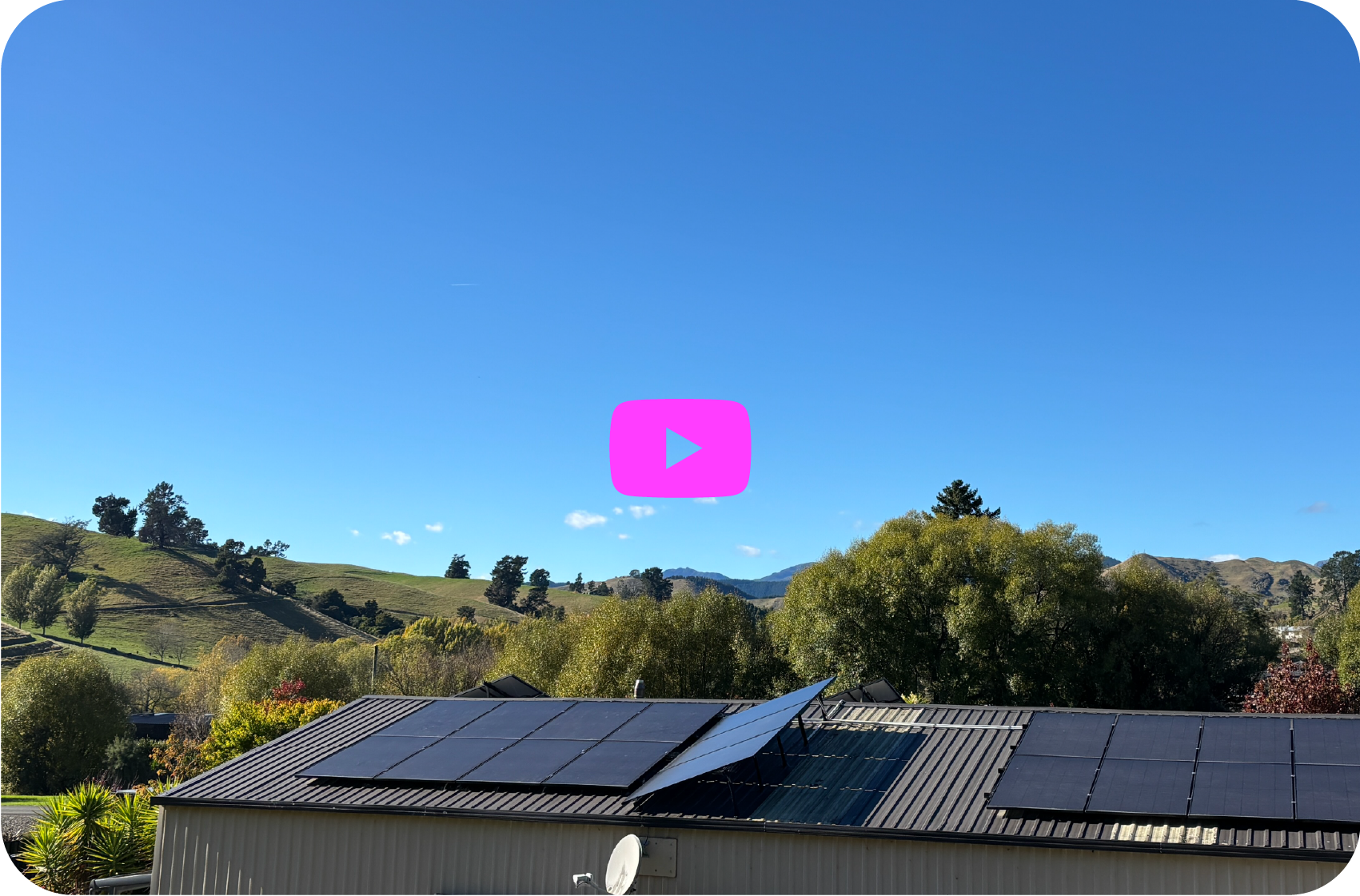
Watch the conversation here or read the transcript below.
Switching to a solar and battery system offers a range of benefits that make sense for your home and the planet.
By generating your own electricity, you can significantly lower or even eliminate power bills and gain additional savings by selling excess energy back to us.
A battery system further enhances these benefits by allowing you to store energy for use when power is most expensive and providing reliable backup power during outages, ensuring peace of mind.
Best of all, using renewable energy helps reduce your carbon footprint, contributing to a more sustainable future.
Learn more about our solar and battery plans here.
Let get into the kōrero with John.
Byron: So, we're at John's place, and John's got a really cool solar setup. We're going to talk with him about why he's done that and what the benefits are that have come from it. So, John, what was the thing that made you get solar in the first place?
John: Well, to tell you the honest truth, I come from Montana in America, and I lived in an area that is the size of half of the north part of the South Island. And that's the size of our county with 2,500 people, and 5 million acres of National Forest. I worked for the Forest Service, so we had to learn to be self-sufficient and live off-grid as much as possible. So it was sort of ingrained in me, and that's the way I was raised, too, on a farm. And so with that, and learning to just do for myself, I've always had that in me. So I maintain these water tanks and have the solar all to be sure that we're ready for off-grid if we need to be. And it's okay to have the backup and all that we need, but just in case something should happen, we want to be prepared for it. With us over there, in Montana, it was mostly the weather, and we would get like three meters of snow every year, so you had to really have your act together. But that's the reason why we decided to go this way, and it's worked out pretty good so far. We're happy to do it, and we're happy to send some back to the grid. Don't forget that!
Byron: Awesome! So the focus was on, you know, self-sufficiency, preparing for emergencies if they do happen, things like that. And what kind of benefits have you been seeing from having the solar system?
John: Well, when we had the power go off last year, last July, when we had the flooding and all that, we had no power here in Tasman. But we actually had power here and no one else did. In fact, we had to help out our neighbors a little bit. But getting back, we wanted to be sure that we could stand whatever happens. But it just seems like, economically, it's going to work out in the future, if I live that long, of course!
Byron: Cool. Yeah, so you went with getting batteries in as well. So obviously that has certain benefits. Would you like to talk about those?
John: Well, it's just a good backup. I mean, that's the whole reason for the batteries. You can figure that out, but you've got to be sure that it's consistent with what you have in the way of paneling, because if it's not, then it's all for nothing. But still, regardless, you want to keep it so it's comfortable on both levels - how much power is coming in and how much is being stored.
Byron: Yeah, cool. It gives you a good system to monitor what everything is doing, and you know, that little bit of control that you don't get if you don't have the battery. Being at the mercy of the sun isn't always the easiest.
John: Exactly. Of course, we're in, you know, Tasman District, we got plenty of sun!
Byron: Yeah, exactly. And you did mention when we were talking before, John, you have an EV as well. So we do have a lot of our customers that do have electric vehicles, and we find that that pairs real well with solar as well. Have you found that that kind of marries up?
John: We'll charge up here, but it takes quite a bit longer than if you go to one of the networks in town. So if we're out popping around, we might top off that way. But if we've got the time, we'll just plug it in. It takes about anywhere from six to seven hours, depending how low you are. But it's still well worth it.
Byron: Awesome. Yeah, so just as a finishing note, John, how much would you recommend solar to everyone else?
John: Well, I want to see what solar companies offer before I answer that! I got to get paid for what I say! Haha. No, no, no, I do recommend it, obviously, or I wouldn't be doing it. But it depends on where you live and what your needs are, but it's nice to have a backup and you never know, especially when we're rural like we are. So, it makes a difference.
Byron: Yeah. Cool, well thank you very much for talking to us, John.
John: Well, right on, yeah. Nice to meet you. I'm sorry I'm so full of crap (laughing).
Byron: Only good information! Thank you, John.
