
Octopus Labs
Queenstown Lakes battery flexing with Aurora
Use your battery to help keep the power supply in the Queenstown area secure and get paid for it!
Got a home battery or a V2G (Vehicle-to-Grid) setup in the Queenstown region? Join Intelligent Octopus scheme in partnership with Aurora Energy. There are a limited number of spaces, so get in quick!
Over the next two winters we’re partnering with Aurora Energy to use our Intelligent Battery control to help balance the local grid during periods of peak demand. If you have a home battery or V2G set up that can connect to our Intelligent Octopus platform you can help Aurora defer the need for expensive network infrastructure upgrades, and make a tidy profit while you're at it.
Your home battery or V2G set up will need to be compatible with Intelligent Octopus in order to participate. Sign up today and get paid up to 5-20c/kWh (70c/kWh for Arrowtown) on battery discharge (yes you read it correctly, the amount discharged from the battery rather than exported energy) during Aurora’s specified peak times. This is in addition to the normal Octopus export tariff.
Winter dates: 1 May - 30 September 2026 and 2027 (weekdays only)
Peak times: Generally 7-10am, 5-9pm Weekdays, but varies depending on network area (please refer to the table below). Your network area depends on the network connection to your property, we will confirm the exact times applicable to your property.
View location & timetable
Restrictions:
Earn credit for discharging in specified times
No charging from the grid during the “no charge” times
If you charge in a “no charge” time, you will not receive the discharge credit for that day.
You must maintain a connection between the battery and Intelligent Octopus (onboarded the device through the app, not disconnect from the app, maintain wifi connectivity)
This is a beta trial - it won’t be perfect but you can help us make the electricity system work smarter
This is a beta trial. Performance of your battery and our technology depends on the wifi and communications connections, they’ll work most of the time but not every time. By agreeing to participate in this trial you accept that there is a risk of us not being able to optimise your battery, or that usage takes place at suboptimal times. If there is a problem that prevents us optimising your battery or we are unable to automatically collect the information to confirm its performance, as required by the network, you will not be paid for your discharge.
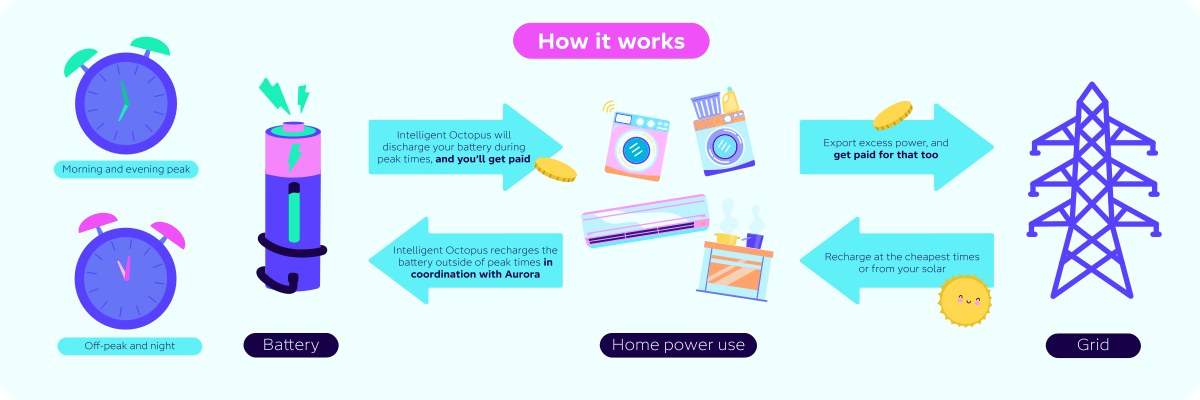
How it works
1) You need to have a battery or V2G set up that is capable of connecting with our Intelligent Octopus system. To be eligible for the credits, Aurora requires us to send instructions directly to the battery. This ensures that the battery is working with the local constraints on the network in an organised way.
Is my battery eligible?
To join the scheme, you need to be an Octopus customer in the Queenstown region with a V2G setup or a compatible home battery. Currently, our Intelligent Octopus tech integrates seamlessly with:
SigEnergy
AlphaESS
Enphase
GivEnergy
Solax (coming soon)
SolarEdge* (coming soon)
(Don't see your battery here? Complete this Integration Request and we’ll keep you updated on our progress)
*SolarEdge charges an additional fee for this service which unfortunately we will need to pass on to you. This will be $7.50 per month whilst the battery is integrated with Octopus.
2) Using our mobile app, you connect your battery to our Intelligent Octopus system. This allows us to connect to your battery for remote control, and to receive the energy usage information.
3) From there, you just sit back and let us do the heavy lifting. We then send instructions hour by hour for when the battery needs to charge and discharge to be eligible for the credits:
Smart Charging: Intelligent Octopus recharges your battery outside of peak times as required by Aurora to be eligible for the discharge credits.
Peak Discharging: We will discharge your battery during your area's morning and evening peak times in order to be eligible for the Aurora discharge credits.
Get Paid: You get paid for every kWh your battery discharges into the Aurora peak discharge periods. The data will be sent to Aurora to process payments at the end of each month. You'll see the credit on your Octopus account around the middle of the following month.
Export for More: If you export excess power back to the grid, you get paid for that too based on your usual Octopus export rates.
4) The discharge credits will appear on your account in the following month. For example, any credits for battery discharge in May, would be applied to your account around mid June.
Aurora flex discharge credits
The credit applicable to your property is determined by its physical connection to the electricity network, rather than the postcode associated with the address. We will confirm what area you are in.
| Area | Peak discharge times | Times of no charging | Credit ($/kWh) |
|---|---|---|---|
| QUEENSTOWN | Weekdays only | Weekdays only | |
| Arrowtown | 7am–10am, 7pm–8pm | 6am–1pm, 4pm–11pm | $0.70 |
| Commonage | 5pm–9pm | 6am–1pm, 4pm–11pm | $0.12 |
| Coronet Peak | 7am–11am | 6am–1pm, 4pm–11pm | $0.12 |
| Dalefield | 6pm – 10pm | 6am–1pm, 4pm–11pm | $0.12 |
| Fernhill | 5pm–9pm | 6am–1pm, 4pm–11pm | $0.12 |
| Frankton | 7am–10am, 5pm–8pm | 6am–1pm, 4pm–11pm | $0.05 |
| Queenstown | 9am–12pm, 5pm–7pm | 6am–1pm, 4pm–11pm | $0.07 |
| Remarkables | 6am–10am | 5am–1pm, 4pm–11pm | $0.12 |
| UPPER CLUTHA | Weekdays only | Weekdays only | |
| Camp Hill | 7am–8am, 5pm–10pm | 6am–1pm, 4pm–11pm | $0.20 |
| Cardrona | 5am – 8am | 4am–1pm, 4pm–11pm | $0.05 |
| Lindis Crossing | 7am–8am, 5pm–10pm | 6am–1pm, 4pm–11pm | $0.17 |
| Queensberry | 10am–12pm, 3pm–6pm | 6am–1pm, 2pm–11pm | $0.05 |
| Wanaka | 7am–10am, 6pm–9pm | 6am–1pm, 4pm–11pm | $0.07 |
The Financials: Let's talk numbers
This is cool but it’s a little complicated, so please bear with us! The discharge credits are in addition to your normal export credits. You do not need to change plans to get them.
They apply during winter months (May-September, weekdays only) as follows:
1) The Discharge Credit: You get paid for the amount of electricity discharged from your battery into your home or exported to the grid. You earn these credits even if you are using battery power to run your heat pump, cook dinner, or watch TV!
2) The Export Credits still apply…and network rebates too: If the battery is outputting more power than your home is using at the time, the excess is exported to the grid.
The discharge credit times mostly overlap with our Octopus peak times, so on top of the discharge credit, exported energy earns you the normal Octopus export rate (19c peak per kWh or 14c off peak for OctopusFlexi, and 23c peak or 10c off peak per kWh for OctopusPeaker).
Plus exports during Aurora’s winter peak times will earn an extra 3c or 7.5c per kWh thanks to their network rebate. From 1 April 2026, all network companies are required to pay you for export during their “peak” times. Aurora's peak rebate times are 7am-12pm, and 5pm-10pm from 1 May to 30 September. The rebate amount varies by location: 3c per kWh in Dunedin and 7.5c per kWh in Central Otago, Wanaka and Queenstown.
Why are Octopus and Aurora doing this?
Demand for electricity in the Queenstown and Upper Clutha areas is growing fast. Traditionally, the only way to meet this peak winter demand was to build massive, expensive new power lines and substations.
We think there's a better way. By teaming up with Aurora Energy, we’re giving consumers the opportunity to use the batteries they own to provide "non-network capacity support" and be paid for it. By discharging your battery during peak times, we can avoid those peaks , create a more balanced grid , and save millions in infrastructure costs. We think it's only fair that those savings end up directly in your pocket.
Ready to flex your power?
Get in touch with us to enrol for the scheme and check the exact area your property is in.
FAQs
To qualify for the discharge credits, Aurora requires us to be able to measure and monitor when you are charging and discharging your battery. You will only be eligible for the discharge credit if your battery operates within the timeframes set by Aurora. Intelligent Octopus allows us to collect battery usage data and optimise the battery within the rules and restrictions Aurora has set.
The short answer is yes, but you’ll still need to be connected to Intelligent Octopus. Intelligent Octopus allows us to gather your batteries charging and discharging data. We need to supply this to the network in order to be eligible for the discharge credits.
Intelligent Octopus can also optimise your battery, which we recommend.
However, if you’d prefer to use your own timers or smart controls, we can provide the required charging and discharging schedules for you to manage the battery yourself. You will only receive the discharge credit if your battery is used within the parameters set by the network. If this is something you’re interested in, email us or give us a call and we’ll switch the control mode to “read only”. This allows us to continue receiving the required device data while you retain control of the battery.
Please note that we must still be able to receive data directly from your device so we can submit the required information to Aurora. Customer-supplied data or screenshots cannot be accepted as evidence of discharge activity.
We’d love to give you an exact number, but it depends a lot on your specific situation including: battery size, operational limits, your wifi connection, and your underlying pricing plan.
Let's look at an example using a 13kWh battery with a maximum discharge rate of 10kW, doing one full charge/discharge cycle per day.
Peak periods happen during winter weekdays (Monday to Friday, May to September), which gives us about 22 days per month. If we assume you use exactly half of the battery's power (6.5kWh) to run your house during the peak, and export the other half (6.5kWh) to the grid, here is how the numbers work out:
Here are the rates we are using for this example:
Aurora discharge credit: 12c / kWh
Octopus Peaker plan export credits as per customers existing pricing plan:
Octopus Peaker export credit: 23c / kWh
Aurora peak injection credit: 7.5c / kWh
Credit made from discharge and export:
Discharge: 13kWh @ 12c = $1.56 per day (or $34.32 per month).
Export: 6.5kWh @ 30.5c (23c + 7.5c) = $1.98 per day (or $43.62 per month).
Total: $77.98 per month
The Arrowtown Scenario:
Because the Arrowtown area has a higher maximum price for peak response, your credits could be even higher!
Here are the rates we are using for this example:
Aurora discharge credit: 70c / kWh
Octopus Peaker plan export credits as per customers existing pricing plan:
Octopus Peaker export credit: 23c / kWh
Aurora peak injection credit: 7.5c / kWh
Credit made from discharge and export:
Discharge: 13kWh @ 70c = $9.10 per day (or $200.20 per month).
Export: 6.5kWh @ 30.5c (23c + 7.5c) = $1.98 per day (or $43.62 per month).
Total: $243.82 per month
The Reality Check
In the real world, your actual credits are very likely to be a bit lower than this perfect scenario. Here are a few reasons why:
Hardware limits: Your battery has built-in safety limits. Manufacturers usually restrict a battery from draining to absolute zero, so you might not get a full 13kWh discharge every single time.
Safety overrides: Battery systems have very conservative safety features (which is a good thing!). They will often step in and override our smart controls to protect themselves from things like local power spikes. When this happens, the battery might not respond exactly as we planned.
Connection hiccups: To claim the credits from Aurora, we need to be able to send controls to your battery and receive its data. If your home wifi drops out, or if there are connectivity issues with the manufacturer's systems, we temporarily lose that connection and can't log the event.
This is technically referred to as the “daily cycle limit”. Generally speaking battery manufacturers recommend (and often physically restrict) a daily cycle limit of 1. Cycling your battery more than once per day could void the battery warranty.
So if you have a 13kWh battery, at most, we can expect the battery to discharge 13kWh per day. Even if there is technically time to charge it back up between peak periods. But for now, we’re sticking with a single cycle.
Absolutely, we always want to keep you in control. Give us a call and we can do it whilst we have you on the phone. Just bear in mind you will not be eligible for the Aurora Discharge credits if your battery charges in the “no charge” times or if we lose the data feed.
We submit the evidence to Aurora on a monthly basis. They analyse the data and confirm the amounts we are to credit you. We hope to have the credits ready for you by the middle of the following month.
Your normal Octopus export credits are unchanged, you'll see them on the usual page of your statement.
You'll also see two credits on a subequent page. One for the network rebate and one for the Aurora discharge credit. These credits will offset against any amounts you owe us for electricity usage during the month.
If your monthly bill is sent out in the first few days of the month, before the Aurora discharge credits or network rebates are applied, you would see (for example) your May credits on your July bill. You will be able to see them in your online account as soon as they are applied in mid June.
As per our terms and conditions, you can apply for excess account credit to be paid out to your bank account once per year and only once you have been a customer with us for one year.
Most batteries are designed to always soak up any excess solar during the day. We will however want to make sure your battery is topped up as much as it can to make the most of these peak credits for you. You will be charged at your usual rates for all battery charging from the grid. We will do our best to restrict charging of your battery to the cheapest times.
Once we connect to your battery, we are able to both receive data, and issue commands (aka “dispatches”) to your battery. Although commands is probably a strong word, they’re just requests to charge or discharge at a certain time. We take the specific charging and discharging schedule from Aurora for your property and overlay the half hourly wholesale energy price forecast for the region. We’ll prioritise the schedule from Aurora to maximise the credits they’re offering, and if there’s scope to further optimise exactly when to charge or discharge, we’ll do so according to the wholesale forecast. This is a more real time indication of when the wider region is indicating a good or bad time to charge/discharge.
At any point you can always pause the control. For example if you were concerned about an upcoming storm that might trigger power outages, you can always change the minimum charge level to hold back some reserves. Just bear in mind the restrictions on charging and discharging times mentioned above as you might forfeit the Aurora credits for the day by doing so.
No, you’re reading that right. Arrowtown is a notable exception in the Aurora flex pilot, where they are prepared to pay a significantly higher rate for battery discharge. This premium reflects the particularly constrained electrical network in Arrowtown. Since upgrading the local infrastructure (poles and wires) to cope with rising power demand would be exceptionally costly (which residents ultimately end up paying through increased power rates), Aurora is trying a different approach - encouraging residents to install batteries. By coordinating these batteries through Intelligent Octopus, Aurora achieves a mutually beneficial solution: residents are rewarded for their participation, and the need for expensive grid upgrades is avoided or delayed.
If you have a Tesla Powerwall, unfortunately the third party services that Tesla offer for their Powerwalls is not compatible with the requirements for this scheme to pass on the full benefits.
However, we can offer you the Flex payments from Aurora as a top up for power exported to the grid. Unfortunately this means you wouldn't get the payment for self consumption during the peak times, but would mean you could increase the credits you get from grid export (buy back). Please drop us an email and we can help set this up for you.
Subscribe to our monthly newsletter
Be the first one to know about news, product information and special offers.