If power prices are going up, why are solar export rates going down?
We agree that it seems counter-intuitive and unfair. However, the reality is that import and export are not linked in any way.

The price of a kWh imported from the grid includes the cost of transporting that power up or down the country, the cost of your local network’s transformers and power lines, the price of your retailer’s future wholesale power contracts, the Electricity Authority levy, and GST.
Solar export includes no other costs and is immediately sold on the “spot” market for whatever the prevailing price is at the time.
So, what makes up the value of one kWh imported from the grid? Here’s a very approximate peak and off peak cost breakdown for a Wellington low user plan…
| 1kWh Imported from the Grid | Peak (per kWh) | Off Peak (per kWh) |
|---|---|---|
| Retailer’s “hedged” electricity cost (wholesale power contracts are locked in up to four years in advance) | 18c | 13c |
| Network variable component (includes some for Transpower for transmission and network company costs for the local lines and transformers) | 17.67c | 5.67c |
| Electricity Authority levy | 0.14c | 0.14c |
| GST | 5.37c | 2.82c |
| Total (incl. GST) | 41.18c | 21.63c |
Meanwhile, on the export side, no matter who your power company is, any energy you export is immediately sold to the market at the current wholesale (or “spot”) price. That’s the price your power company gets for your export - they don’t sell it to their other customers at inflated prices as many believe.
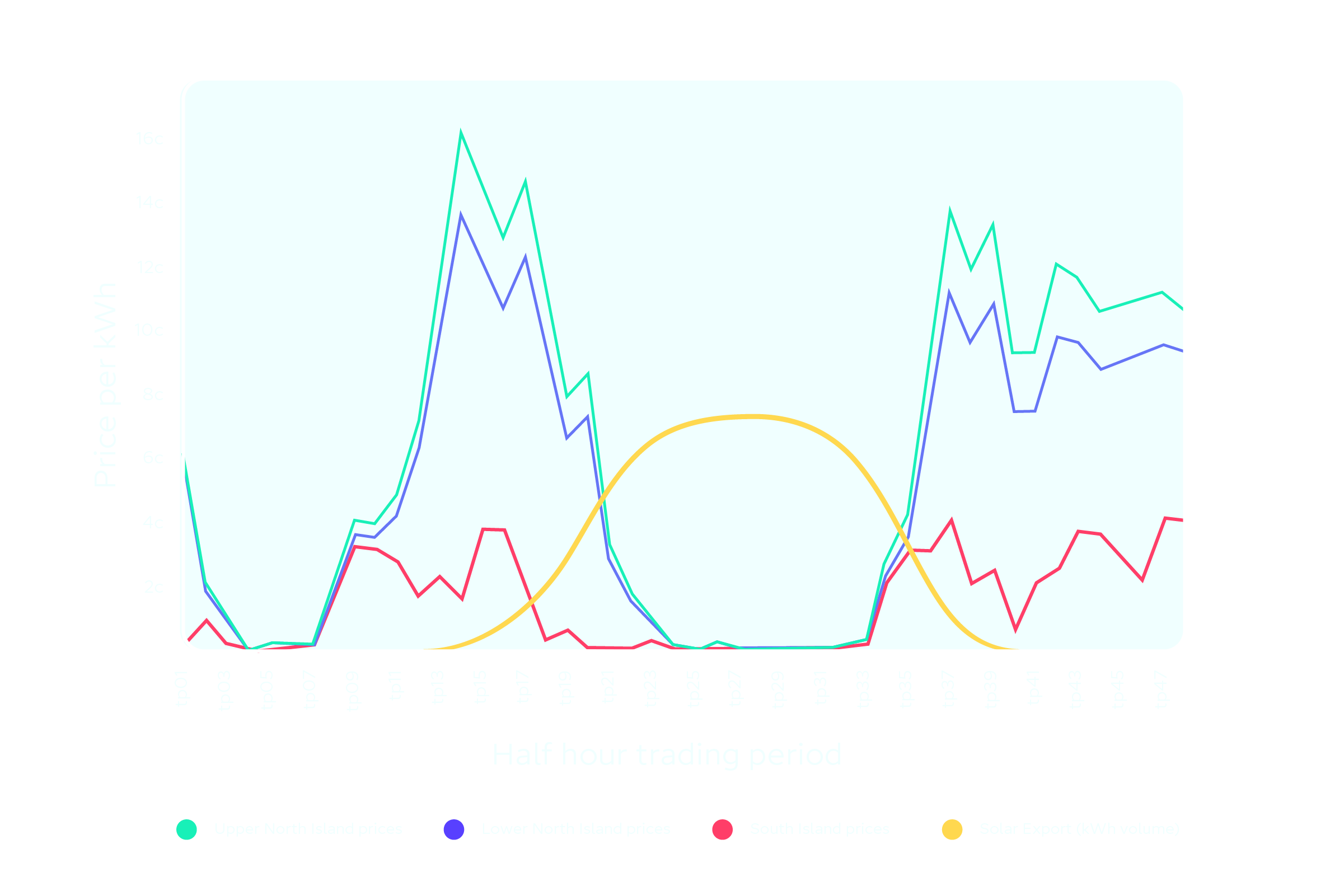
This graph shows a fairly typical sunny spring day. The amount being exported (the yellow line) peaks around the same time spot prices drop to around zero - that’s 11:30am (trading period 24) through to 4pm (trading period 33). Meaning your retailer is paying you anywhere from 8c to 16c per kWh and getting less than a cent in return.
In Australia they sometimes see negative prices at times of high solar - where you have to pay to export. We could easily get to that situation, as we don’t have the sunny day demand for air conditioning that they do across the ditch.
Does that mean solar is a problem?
Absolutely not, solar is great for the country! When the sun is shining and people are exporting, hydro generators can dial things down and save the water for when we really need it.
But it also makes balancing things at the local level difficult.
Power lines and transformers have limited capacity and too much solar in one area can create “traffic jams”. Just like the roads would get blocked if everyone in your neighbourhood decided to head out in their cars at exactly the same time.
That’s why New Zealand lines companies have export limits in place and three networks even charge up to a cent per kWh exported.
The Electricity Authority changed the regulations earlier this year, increasing the default export limit to 10kW for residential connections. An increased export limit is useful, but mainly at peak, high-demand times - outside of that it’s just pumping more juice into an already over-supplied system.
Because of this we recommend sizing your solar system for your own consumption, not export payouts. Depending on where you are in New Zealand, you’ll be faced with off-peak prices anywhere from 21c to 50c per kWh and peak rates from 28c per kWh to north of 60c. Avoiding these costs by using your own generation easily beats the rates you can get from exporting.
The ideal scenario is to use most of your generation and export a little… taking pressure off the grid while not adding to the export congestion. Even better, adding a battery can enable you to completely avoid expensive peak usage and export any excess when the grid actually needs more power and it’s worth something.
